
This is an old revision of the document!
Table of Contents
jPC - Industrial ARM Embedded Linux Panel PC
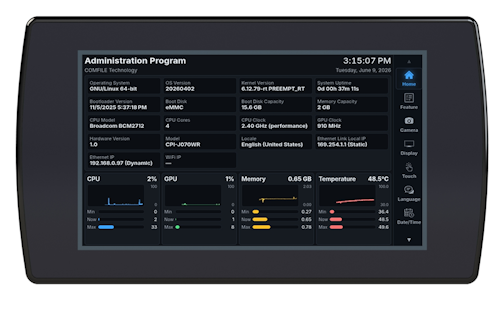
The CPi-J070WR (jPC) is an ARM industrial panel PC designed to be a practical successor and generational upgrade to the Windows CE–based CUWIN, while preserving what made it great: an excellent platform for developing industrial HMI solutions in .NET.
Although the panel PC runs embedded Linux, the panel PC can be programmed using the latest versions of Windows' software development tools, including Visual Studio 2026, C# (v14), .NET (v10), WinForms, and even supports remote deployment and debugging from within the IDE.
But it gets even better! Because ARM Linux is an officially supported .NET target platform, developers are no longer limited to a crippled “Compact” framework. Windows development PCs and the panel PC share the same modern .NET SDK, runtime, and libraries, so most applications can be developed and debugged (hot reload too!) on a Windows PC and then deployed to the panel PC with minimal or no code changes.
Also, the panel PC's operating system is much more full-featured than Windows CE or Windows Embedded Compact. It provides a modern web server, a modern web browser (for Kiosks), remote desktop, secure shell, and much, much more. It may be small and compact, but it can be more capable than many Windows x86 industrial panel PCs while still being programmed like one.
Features
The panel PC's operating system is very efficient, consuming only about 250MB, leaving almost 90% of the device's memory available for resource-demanding solutions.
Getting Started
Theory of Operation
IO Features
Software Development
FAQ
Why did we develop the jPC?
Many people ask us, “Since you already have the ComfilePi, why did you create another panel PC?”
To put it simply, the jPC and the ComfilePi are products built on completely different foundations.
The ComfilePi is a touch panel PC based on the Raspberry Pi ecosystem. Its greatest advantage is the ability to leverage the vast Raspberry Pi community and a wide array of open-source software. In fact, many of our customers successfully build various systems using the ComfilePi.
However, existing CUWIN (Windows CE) users faced a different set of dilemmas.
Has Windows CE come to an end?
CUWIN has been a reliable fixture in industrial environments for a very long time. It was a stable and user-friendly platform, but Windows CE has reached its official end-of-life (EOL). Developing new products on it has become increasingly impractical.
As a result, existing CUWIN users have found themselves at a crossroads, pondering which platform to transition to next.
Why Linux?
Today, Linux is the most realistic and viable choice for industrial embedded systems.
Linux offers long-term maintenance, supports a vast range of development tools, and frees you from vendor lock-in.
That is why we chose Linux as the foundation for our next-generation CUWIN platform.
Then, isn't the ComfilePi enough?
The ComfilePi is indeed an excellent product.
However, the ComfilePi is ultimately bound to the Raspberry Pi platform. Therefore, maintaining compatibility with the existing Raspberry Pi ecosystem is a top priority for it.
On the other hand, industrial fields demand strict requirements that differ from general-purpose PCs:
- Sudden power cutoffs
- Long-term, non-stop operation
- Predictable, real-time responsiveness
- Standardization of the development environment
- Simplification of on-site maintenance
To freely modify and optimize the operating system tailored to these specific demands, an independent platform was absolutely necessary.
What exactly is the difference?
The jPC is not just another panel PC with Linux installed.
It is an embedded Linux platform precision-engineered for long-term reliability in harsh industrial environments.
To achieve this, the operating system (OS) has been meticulously tuned at a granular level. This is exactly where Comfile Technology's 20 years of on-site expertise and technical know-how come into play.
- System configuration designed for abrupt power loss (Partition separation)
- Real-Time operation support
- Built-in .NET development environment
- System optimization tailored for industrial equipment
- Platform design geared for long-term maintenance
Which product should I choose?
If you want to leverage the rich Raspberry Pi ecosystem and various open-source projects, the ComfilePi is a great choice. Conversely, if you need a system that runs stably over the long haul in an industrial field, or if you plan to develop .NET-based industrial applications, the jPC is the more suitable option.
These two products are not competitors.
The ComfilePi is for customers who want to utilize the Raspberry Pi platform, while the jPC is for those who need a next-generation CUWIN. We offer both solutions so that you can choose the platform that best fits your specific goals.